

Phase Contrast Microscopes
What Is Phase Contrast?
Phase contrast is a method used in microscopy and developed in the early 20th century by Frits Zernike. Zernike discovered that if you speed up the direct light path, you can cause destructive interference patterns in the viewed image. These patterns make details in the image appear darker against a light background. To cause these interference patterns, Zernike developed a system of rings located both in the objective lens and in the condenser system. When aligned properly, light waves emitted from the illuminator arrive at your eye 1/2 wavelength out of phase. The image of the specimen then becomes greatly enhanced. Phase is only useful on specimens that are colorless and transparent and usually difficult to distinguish from their surroundings. We call these specimens "phase objects". Examples of phase objects include cell parts in protozoans, bacteria, sperm tails and other types of unstained cells. This phase contrast technique proved to be such an advancement in microscopy that Zernike was awarded the Nobel prize (physics) in 1953. See more on Frits Zernike biography.
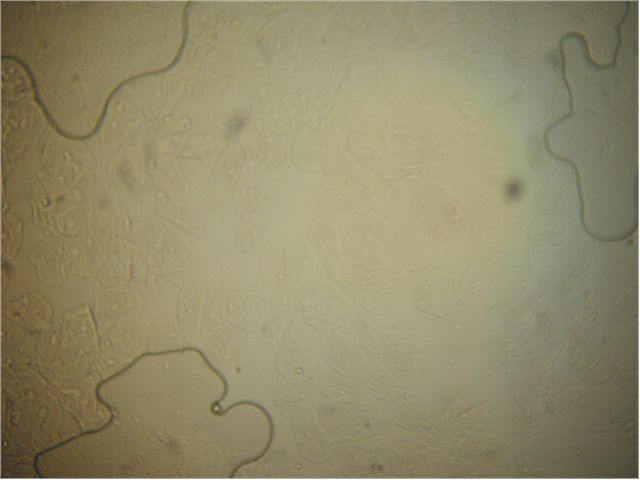
Cheek cells captured with regular brightfield objectives.
Notice the air bubbles at three locations, some cells are visible on the left.
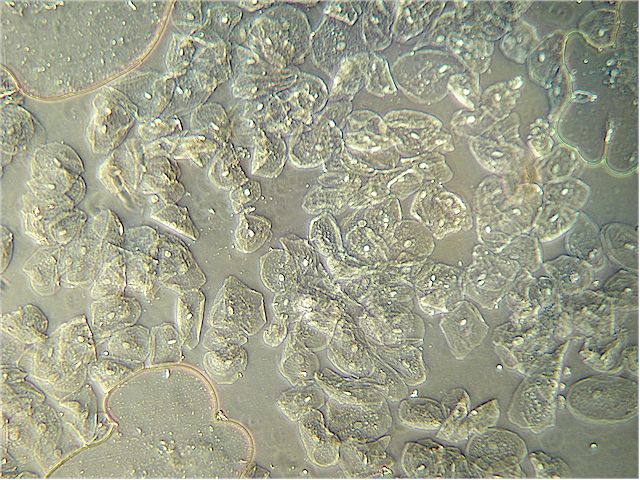
Cheek cells captured with phase contrast objectives.
The same image with phase contrast, nuclei are white dots inside each cell.
About the images above: A common activity in a high school biology class is to observe cheek cells. To do this, you take a flat toothpick and gently scrape the inside of your cheek. You then smear the saliva specimen on a flat microscope slide and cover it with a cover slip. The cheek cells are epithelial cells and will be seen in large numbers. The students then add a drop of iodine to the sample and the nuclei of the cells become visible as small round dots inside the cell.
In the two pictures above, we see the cells as they would appear without iodine with a regular microscope. At the right, you see the same specimen using a phase contrast microscope (actually, I used the same microscope with different lenses). This clearly shows that, for some specimens (called Phase Objects), a phase contrast microscope will greatly improve you image quality.
Setting Up Your Microscope for Phase Contrast Observations
(You must have special phase objective lenses and a phase substage condenser.)
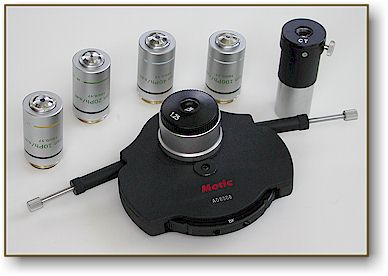
Shown at left is the phase contrast kit used on the National Optical 169 series microscopes. It consists of 4 objective lenses, a centering telescope and Zernike phase condenser lens.
The long adjustment screws on the phase condenser push in to engage set screws for proper alignment of the phase ring.
There is a thumb wheel on the opposite side used to dial in the proper setting to match the power of the objective lens. There is also a "BF" setting on the thumb wheel for brightfield. This allows you to use the phase objectives as standard brightfield lenses.
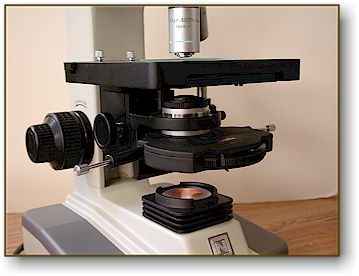
Not all phase contrast microscopes are the same but generally they rely on similar techniques to set up the system for optimum results. In the system shown at the left, the phase condenser has five settings that you spin with your thumb ( 10x, 20x, 40x, 100x and BF) BF is "brightfield", no phase.
To set up your microscope for phase optics, you first set it at BF and focus on the specimen. Adjust the height of the condenser for optimum image quality. Next, set the condenser turret to the phase setting for that particular lens and remove the specimen.
The controls that stick out from both sides on the back are for centering the condenser.
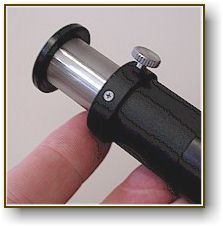
Next, you remove one of the eyepiece lenses and insert the centering telescope in its place. The set screw is used to focus the centering telescope.
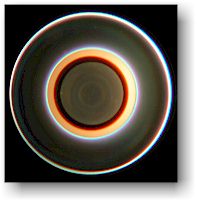
When looking through the telescope, you will see two rings. They may or may not be concentric. By turning centering adjustment screws on the condenser, you align the rings so that they become concentric.
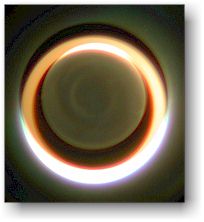
View you might see before alignment of the phase condenser.
Once aligned and optimized for phase contrast microscopy.
You then remove the centering telescope and replace the eyepiece lens. Put your specimen back on the stage and you are ready for phase observations. When you change objectives, you should go through this procedure again (although you may discover that the alignment remains consistent with all objectives).
One final note. Your phase contrast microscope might also be a darkfield microscope! You will likely discover that when you set the condenser to a different phase setting than the chosen lens you will get a nice darkfield effect. So you are getting a pseudo darkfield microscope as well as a phase contrast instrument! This will show your specimen, not as a phase image, but illuminated on a black background.
View recommended suppliers to view phase contrast models and prices.