
Different Types of Light Microscopes

A "light" microscope is one that relies on light to produce the viewed image. There are other types of microscopes that use energy other than light. Examples are scanning electron microscopes (SEM) that use electrons and scanning probe microscopes that use electromagnetic fields or tiny probes which measure forces. If we study light microscopes, we will find that there are many different types, each one designed for a specific application or job. Below are some of the most common types and a short description of each microscope.


Basic single magnification microscope. This microscope is similar to a magnifying glass and has low magnification power of 20x. It relies on ambient light for illumination and is used for reflected light observations (where light bounces off the specimen and up to your eye). A young person will enjoy looking at bugs, sand grains, fabric weaves, etc. with this type of a microscope.
The microscope at left is a basic introductory biological compound microscope. It is compact in size, and has a carrying handle. This microscope is commonly used in elementary or middle schools. The microscope has three powers: 40x, 100x, 400x and the light is located beneath the stage where the slides are placed. This is a transmitted light microscope, where the light must pass through the specimen (such as a fly wing or cells or pond water critters). You would not be able to place a rock on this type of microscope and view it, since the samples must allow light to pass through them.
This is a full size biological compound microscope, typically used in high school biology classes. The microscope can have three or four magnifications: 40x, 100x, 400x and sometimes 1000x. The light is located under the stage for transmitted illumination. This microscope has a built-in mechanical stage, which makes it much easier for students to maneuver slides on the stage. Rather than moving the slide with fingers to put it into position, one of two knobs is rotated to move the slide on the X or Y axis, providing much more control over sample viewing, especially at higher magnifications.
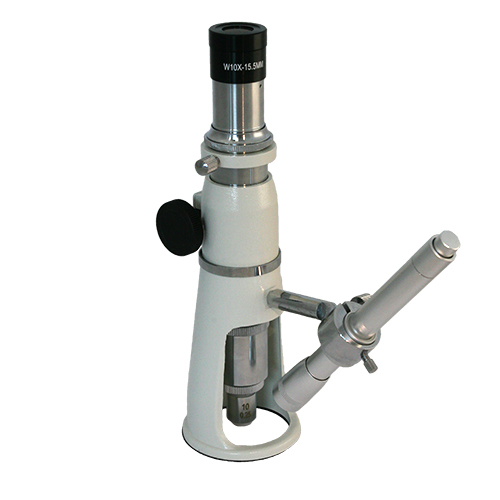
This type of microscope is known as a shop microscope. It uses a small flashlight to illuminate specimens. This type of microscope is placed directly on the specimen and with the light on, you can look through the top and focus on the image. This shop microscope has a built-in eyepiece reticle (a ruler printed on a piece of glass inside the eyepiece) for making measurements. The shop microscope is used in the publishing industry to look at printed material or in the textile industry to look at fabric weaves and color. The microscope only has one single magnification and can typically be ordered with a magnification of 20x, 40x, 50x or 100x.
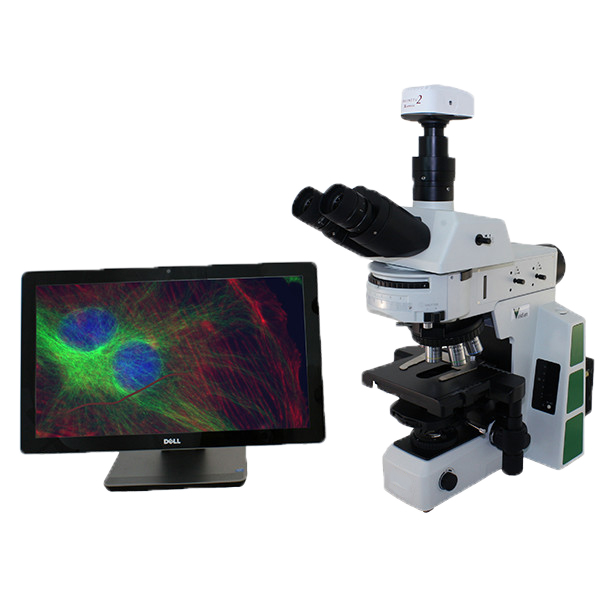
This is a research microscope with fluorescence. Cell biologists use research microscopes that are often fitted with fluorescence illumination. Fluorescence illumination uses different wavelengths of light to view parts of a sample. The fluorescence microscope is the biologist's instrument of choice when it comes to localizing proteins in a sample. Fluorescence microscopes provide an additional level of contrast not seen in a standard brightfield microscope. These microscopes are used by researchers in neuroscience and cell biology.
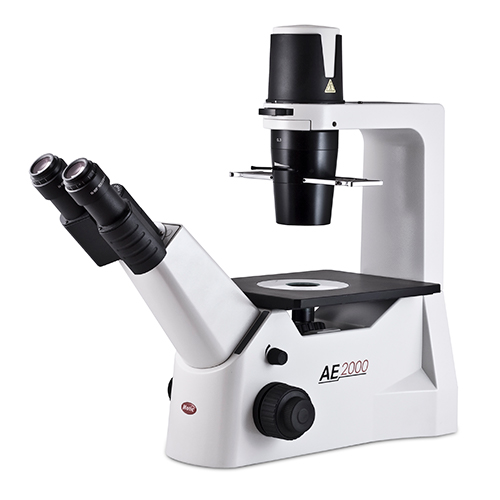
Inverted microscopes are interesting biological microscopes that have the light on top and the objective lenses beneath the stage. Everything seems to be upside down! With this type of microscope, you can put a large object like a petri dish on the stage and easily move it around without the objective lenses getting in the way. The inverted microscope is for transmitted light observations and has magnification powers of 40x, 100x, 200x and 400x. This type of microscope would be found in a University biological lab or in the medical profession.
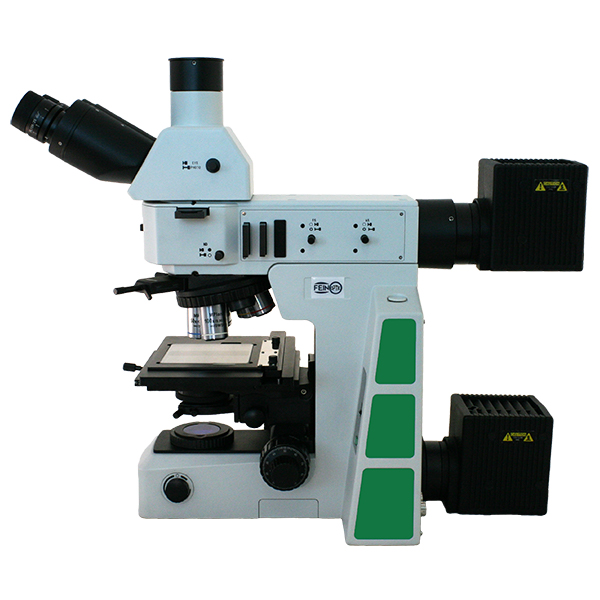
A metallurgical microscope is a high power microscope that has reflected light illumination. Remember how I mentioned that rocks or objects that do not allow light to pass through them can not be viewed with a biological microscope? That was because on a biological microscope the light comes from beneath the stage. On a metallurgical microscope the light is pumped in down through the objective lens, bounces off the specimen and goes back to your eyes, providing reflected light. Some metallurgical microscopes will have both reflected and transmitted light. The reflected light allows you to place objects such as metal or plastic that won't allow light to pass through them on the stage and still a view high magnification of these parts. Metallurgical microscopes typically have magnifications of 40x, 50x, 100x, 200x, 400x, 500x and sometimes 1000x.
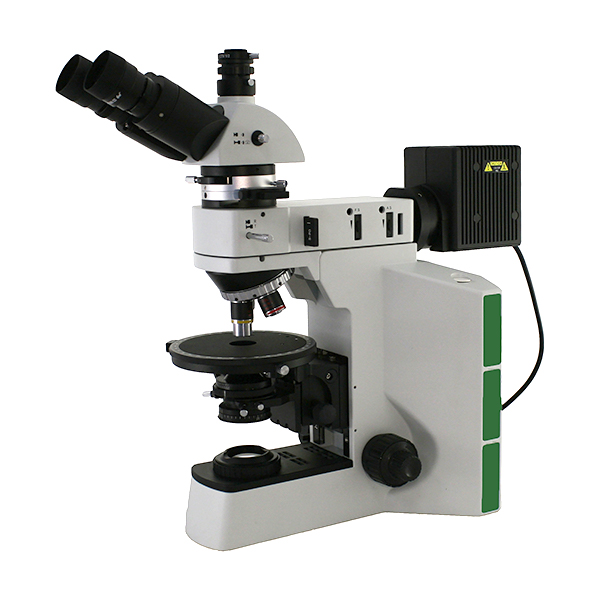
A polarizing microscope is a very special instrument that uses a polarizer and analyzer to look at materials under polarized light. The stage rotates around and with special plates inserted in the light path, you can measure the angles of brightness and color and from a chart of known specimens, identify your sample. Many specimens look quite spectacular under polarized light. A geologist uses a polarized light microscope, as well as the pharmaceutical industry to look at chemical compounds of drugs. View images captured with a polarizing microscope here.


A stereo microscope always needs a top light (reflected light). This light could be built into the stand, or separate from the stand (pipe lights). Some stereo microscopes will also provide transmitted light built into the bottom of the stand (the stereo microscope shown at left has both reflected and transmitted light). A stereo zoom microscope provides continuous zoom range magnification typically in the range of 7x - 45x. Often magnification can be adjusted by changing out the eyepieces or adding an auxiliary lens on the bottom of the stereo microscope body. A stereo microscope has an eyepiece and objective lens for each eye so you will see the specimen in "stereo" or 3D. Stereo microscopes are typically used in industrial settings for quality control and inspection, they are also used by botanists, zoologists and archaeologists.
Stereo zoom microscopes can be mounted on a variety of stands. If you needed to look at really large car parts or large circuit boards, you might use a ball bearing boom stand (shown at left). The microscope is held onto the boom stand with a focusing holder. The types of stands you might find are articulated arm stands, boom stands and ball bearing boom stands. Some of them have large bases and others clamp to the table. When using this type of setup a ring light or dual pipe light illuminator is used. Stereo boom stand microscopes are commonly used in industrial and manufacturing settings where large parts need to be examined for quality control.
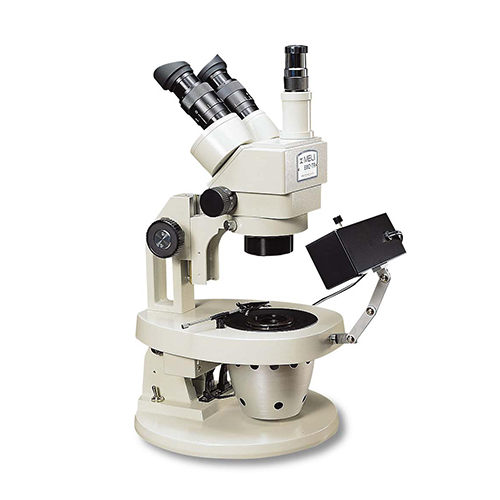
Gemological microscopes are stereo microscopes that have special illumination for looking at gems or minerals. The lower illuminator is brighter and has darkfield operation and the upper illuminator (the black box) is an adjustable fluorescent light. The microscope has a small clip to hold the gemstone in place. When you look through a gemological microscope, it is brightly illuminated and displayed against a black background.


Measuring microscopes are used to make very precise and accurate measurements. This microscope has fine controls that move the stage and measure small distance in the X, Y and Z direction. Measuring microscopes often have three types of magnification including: reflected, transmitted and oblique illumination. Magnification ranges typically cover 20x, 50x, 100x, 100x, 500x and 1000x. Measuring microscopes are used in manufacturing where preciseness is required.
Video inspection microscopes provide a live image on a monitor for inspection purposes. These microscopes are sometimes used for soldering or inspection of small parts to reduce eye fatigue from looking through a microscope for hours on end. Magnification on these inspection microscopes can be anywhere from 25x to 515x depending on the type of lens used.
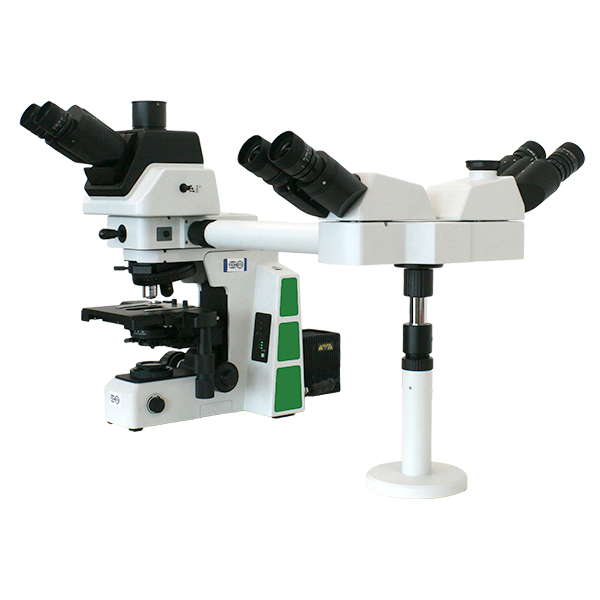
Multi-viewer microscopes, often referred to as dual-head microscope systems are used for teaching in higher education. These microscopes have multiple viewing heads (sometimes up to 5 heads). A LED pointer system in the main microscope allows the instructor to point out specific parts of a specimen while everyone is viewing the same slide.